
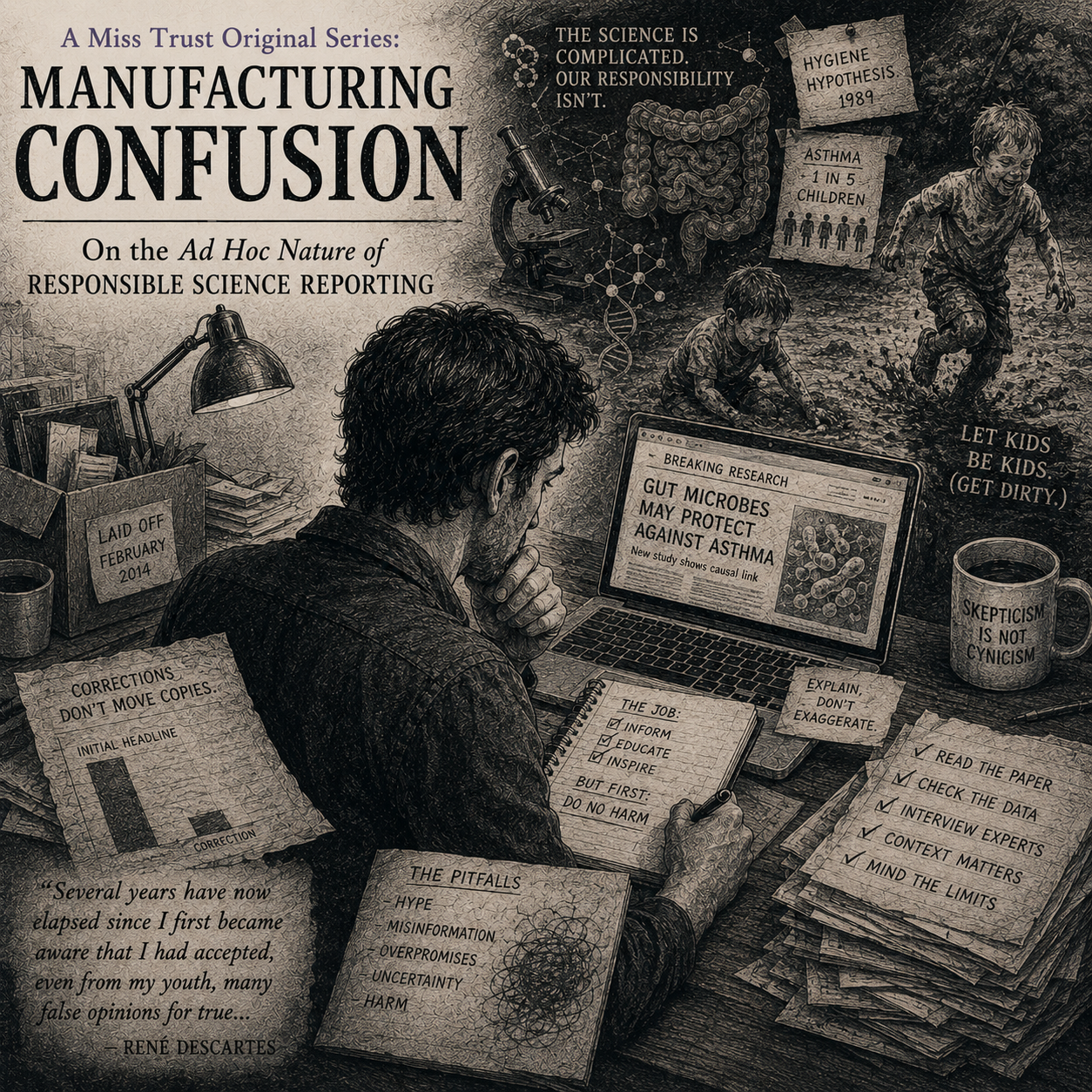
On the Ad Hoc Nature of Responsible Science Reporting
It’s February, 2014. My wife is on maternity leave following the birth of our second child and I’ve just been laid off from my job as Director of Communications at a renewable energy company[1]. Money is very tight and, while halfheartedly looking for another role in corporate communications, I fall back on the one skill in which I have any real confidence. Writing.
Over my years in communications, the act of actually stringing words together had become a progressively smaller and smaller portion of my work. A much larger share of my day-to-day was interfacing with the press. And so, I opened up my rolodex (not literally—I’m not that old) and pitched a jump to the other team.
I had no formal training in journalism. My university degree was in Cognitive Science, a still somewhat obscure discipline best described as “what if linguistics and psychology and philosophy were neuroscience?” My actual studies focused pretty heavily on computer modeling and early artificial intelligence, including a number of classes under Geoffrey Hinton, godfather of AI (and contemporary AI apocalypse doomsayer). I’d parlayed those skills into a short career in computer programming—mostly for accessibility technologies—before transitioning into communications.
The only genuinely journalistic credential to my name was a single short piece featured in Wired magazine a decade prior. But—combined with my experience in science, tech, and energy—it was enough. Freelance assignments started to trickle in. At first, predictably, they were simple explainer pieces about solar and wind power, but then also slightly meatier pieces about accessibility policy and assistive technology. So long as the briefs kept playing to my areas of professional expertise, smooth sailing.
By mid-2014, I’d started to build up a bit of a portfolio, and a reputation for hitting deadlines (which carries more weight in this industry than does a reputation for inspired prose). And so, the day came when an editor reached out to me under time pressure—another journalist had flaked on her—and asked if I felt comfortable reporting on medical research?
“…maybe?”
I found myself interviewing Canadian researchers who had discovered a causal link between the gut microbiome and asthma. I didn’t know anything about asthma or gut flora, but I knew how to read a scientific paper. Diving into the science, I understood very quickly that this research was potentially game-changing. About 1 in 5 Canadian children suffered from chronic asthma, and—worldwide—hundreds of thousands died from asthma complications each year. Up until this point, the best scientific guess for what caused it was a shrug. A mix of genetic and environmental factors? It’s complicated.
Like all science, of course, this study built upon previous research. The idea of a link between the gut microbiome and asthma wasn’t wholly novel[2], but this was the first time a clear causality had been shown, implicating specific microbes. And, if they were right, it not only opened new lines of research for asthma treatment, it also provided some very straightforward prevention guidance for parents. Let your kids get dirty, one of the researchers told me. If children are exposed to a wide range of microbes when they’re young, they’re more likely to be protected against asthma[3].
As a parent of two young children, this immediately set alarm bells ringing in my head. Not because the advice sounded bad. Just the opposite. I grew up in the 80s, a time of rampant dirt-phobia and “clean living.” I was just the right age to be ready for a big pushback on sterile parenting. And I knew I wasn’t the only one. Right around that time, a spate of articles were making similar claims on everything from Crohn’s disease to peanut allergy[4]. I would very much welcome a strong scientific endorsement of my preexisting inclination to let my kids run wild in the muck.
One should always be skeptical of evidence for things one already wants to believe. And a journalist, surely, should be extra cautious about amplifying news that readers are primed to enthusiastically embrace—especially considering that, famously, corrections don’t move copies[5]. In science reporting particularly, once a misleading story is out in the world, it’s impossible to undo the damage[6].
I remember, at the time, thinking that I was out of my depth. I was able to understand the science pretty well for a layman, but I was unsure where my responsibility lay as a reporter. If I’d gone to J-school, I told myself, I’d know exactly how to proceed. Instead, I had to muddle through. I presented the research, I quoted the researchers, and I made sure to include what felt like an appropriate amount of equivocation.
The article was well-received and it wasn’t long at all before I was shoulder tapped for another health piece. And then another. I never did go back to corporate communications. By 2015, I was getting enough freelance writing work to make a full-time go of it (and my wife was back to work, which certainly helped). And by 2020, when all journalism suddenly became health journalism, I had pretty comfortably settled into medical research as one of my regular beats.
I wish I could say that I’ve since developed a surefire way to avoid the pitfalls that worried me in those early days. I haven’t. Every time, I’m still muddling through, trying to find the words that will educate while also preserving just the right degree of skepticism. And, though I know this dilemma does get addressed in journalism school, it’s become clear that every other science journalist is, in practise, muddling right alongside me. It’s also clear that many of them don’t know how to read a scientific paper. So at least I’ve got that.
[1] A position for which, to be completely honest, I was never particularly well suited.
[2] Dr. David Strachan’s “hygiene hypothesis” dates back to 1989.
[3] And allergies. And an increasingly wide range of other chronic conditions that have now been linked to a lack of microbiome diversity.
[4] Everybody Was Wrong About Peanut Allergies. And That’s Okay.
[5] Corrections and retractions are, of course, critically important. But the unfortunate reality is that the article claiming that drinking red wine protects against heart disease will always reach more readers than the follow up article saying oh, wait, scratch that.
[6] For the record, though the 2020s has seen the cyclically predictable beginnings of pushback on the hygiene hypothesis as a whole, the specific findings of this asthma study have proven very solid and they continue to be the foundation of much promising asthma research.