
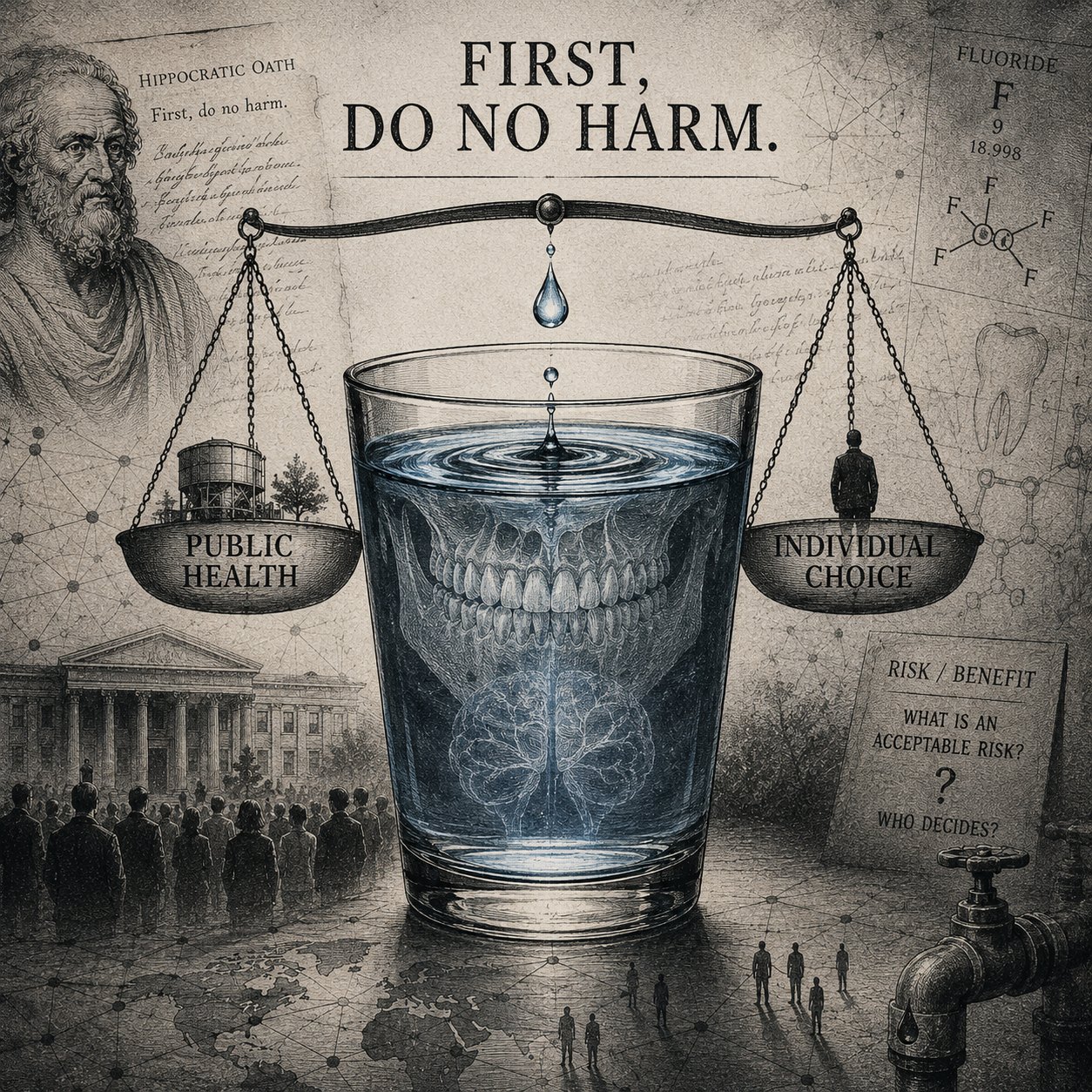
First, do no harm. Such is the guiding principle underlying the fundamental philosophy of modern medicine, dating all the way to the teachings of the Greek physician/philosopher Hippocrates in the fifth century BC[1]. It seems like the simplest mandate. And yet, when we try to apply it, things get real hairy real fast.
Almost every medical treatment carries the potential to do harm. Drugs have side effects. Surgery leaves a wound. The real standard isn’t the total absence of harm but rather doing less harm than good. And, critically, the decision of what constitutes an acceptable harm—or an acceptable risk—rests ultimately with the one receiving the care[2].
That idea of informed consent is, however, far less straightforward when the “patient” is everyone. Public health policies—like vaccine mandates or spraying residential neighbourhoods for disease-laden mosquitoes—pursue collective benefit by making collective decisions around collective risk. But what of those who don’t consent and have no avenue for opting out? This same question sits at the heart of renewed discussion on water fluoridation.
The benefits of fluoride for dental health have been clearly established by scientific evidence dating back almost a century[3]. And good dental health is likewise associated with positive health outcomes throughout the body including heart and respiratory health[4]. Fluoride is in water supplies around the world, although to widely variable degrees. In fact, the initial discovery of the dental benefits of fluoridated water stems from investigation into why people in certain parts of Colorado had healthier teeth than the norm, despite similar dental care practises. The answer, of course, was high natural fluoride levels in their water. From there, it was a simple leap to the idea of standardizing fluoride levels in drinking water elsewhere.
By 1960, about 50 million people in the United States were drinking artificially fluoridated water, and the practise quickly spread to other countries like Canada, Ireland, Brazil, and New Zealand. But not everyone was thrilled. There were, unsurprisingly, conspiracy theories that governments (or communist saboteurs) were using fluoride to intentionally poison the public or render them susceptible to mind control. But there was also a second line of opposition that acknowledged the positive outcomes of water fluoridation (early results showed a 50% to 60% reduction in childhood dental cavities) but objected to a policy that removed individual choice in the matter.
Because, as clear as the benefits of fluoridation are, fluoride does also have the potential to do harm. In those Colorado communities where fluoride’s effects were first discovered, people’s teeth weren’t only unusually strong, they were also unusually discoloured due to what’s now known as dental fluorosis. At optimal levels of fluoridation[5], dental fluorosis is usually minimal and purely aesthetic, but still measurable. Chronic excess intake of fluoride is associated with more severe effects like damaged tooth enamel and bone disease. More worryingly, several studies have suggested that high levels of fluoride[6] can negatively impact neurological and cognitive development in children[7]. The research into the neurocognitive impacts of fluoride is still in its infancy, and the studies that exist have methodological problems that limit the conclusions that can be drawn from them, but there is enough there to warrant further investigation[8].
The improvements in dental health that followed widespread water fluoridation in the U.S. are heralded as one of the great public health wins of the 20th century. But the initial push towards water fluoridation occurred in a context where fluoridated toothpaste did not exist[9] and most people did not have regular access to dentistry. And, though the rate of dental cavities in the U.S. plummeted following early water fluoridation—with American teeth quickly becoming the healthiest in the world—access to fluoridated toothpaste and modern dentistry has since seen dental cavity rates reach par with the U.S. in many countries that have never practised water fluoridation.
On the individual level, fluoride recommendations are relatively easy. Current scientific data overwhelmingly suggests that there is a level of fluoride exposure that provides significant benefit with minimal harm and risk. In a perfect world, every person would achieve optimal fluoride exposure through topical application like rinses and toothpastes, and there would be no need for a debate at all. Those who found the minimal risks unacceptable would simply opt out.
When water supplies are fluoridated, however, opting out verges on impossible. Yes, one could consume only bottled water, but this has a significant cost barrier and fluoride levels in bottled water are rarely disclosed by the manufacturers. There are also home filtration systems that can remove fluoride, but these are expensive and not widely accessible[10]. On the other hand, when water is not fluoridated, there can remain very real barriers to opting in, especially where there is not free and universal access to dental care[11].
So, the question becomes, is it better to create a situation where a public health decision is accepting some risks on behalf of the population at large in service of overall benefit? Or is it better to create a situation where those without access to adequate fluoridation through other means suffer worse dental outcomes in service of informed consent and freedom of choice? This is, ultimately, not a question with a single objective answer.
Informed consent is what makes treatment ethical. It’s not the absence of risk that defines doing no harm, but a clear delineation of benefit over risk and a patient who understands the decision they’re being asked to make. Public health decisions complicate this principle, but even collective decisions do carry a kind of consent. We authorize governments to make them, trusting that they will keep listening, keep measuring, and keep telling us the truth[12].
At the same time, doing nothing is still a choice. Choosing not to intervene is as consequential as intervening, only with the risks and benefits reversed. The harm of inaction can be as real as the harm of action, even if it feels less visible. So “do no harm” can’t mean simply refusing to act. It’s not a get-out-decisions-free card. We really do have to decide where we stand. And while science and critical thinking can help us understand the landscape, they cannot make the ethical and political decisions for us.
[1] “First, do no harm” is often mistakenly attributed to the Hippocratic oath itself, although this phrasing do not appear therein. Still, the Hippocratic oath does compel a physician to “abstain from all intentional wrong-doing and harm,” and the idea is prevalent throughout Hippocrates’ work.
[2] Or whoever has been empowered to make such decisions for them.
[3] The connection between fluoride and reduced dental caries/cavities was first identified by Frederick McKay, G.V. Black, and H.V. Churchill in 1920s and 1930s, leading to a number of epidemiological studies around the world and culminating in H. Trendley Dean’s landmark 1950 paper, “Studies on Mass Control of Dental Caries Through Fluoridation of the Public Water Supply.” https://www.jstor.org/stable/4587515
[4] https://pmc.ncbi.nlm.nih.gov/articles/PMC88948/
[5] Between 0.5 mg/L and 1.0 mg/L according to the World Health Organization; 0.7 mg/L by Health Canada and U.S. Public Health Service recommendations.
[6] The highest quality studies on potential neurocognitive impact show statistically significant results only when water fluoridation levels exceed 1.5 mg/L, whereas the recommended level in the U.S. and Canada is 0.7 mg/L. Although it’s worth noting that actual fluoride consumption is additive, measured in mg, not mg/L. Dosage can thus vary greatly on an individual basis depending on how much water one drinks and how much fluoride exposure one gets from other sources. This variance can be quite relevant given that the dose makes the poison.
[7] https://www.ncbi.nlm.nih.gov/books/NBK567579/ and https://pubmed.ncbi.nlm.nih.gov/39172715/
[8] In the time between the writing and publication of this article, a new paper on this subject has been published in Science Advances entitled “Childhood fluoride exposure and cognition across the life course” (https://www.science.org/doi/10.1126/sciadv.adz0757) analyzing outcomes specifically in the United States and specifically outcomes within the 0.7 mg/L and 1.2 mg/L water fluoridation range. This analysis finds that there is no measurable neurocognitive detriment across this population, which is reassuring. However, this analysis also includes no new primary research. The results from other studies examining higher ranges of fluoride exposure still warrant further research, especially given that in any population individual fluoride exposures can vary dramatically.
[9] Water fluoridation became an official policy of the U.S. Public Health Service in 1951, and the first fluoridated toothpaste came to market in 1956.
[10] Most home water filtration systems are not capable of removing fluoride, but some pricier systems using very low micron filters or reverse osmosis can reduce fluoride concentration by 99% or more.
[11] Some countries try to walk a middle path by fluoridating food staples like salt (France, Germany, Colombia, Jamaica) and milk (Thailand, Russia, Scotland, Chile). This provides some degree of universal access to fluoridation while also making opting out somewhat more practical. The evidence for the effectiveness of milk fluoridation programs, however, is scant.
[12] When that trust erodes, however, all bets are off.