
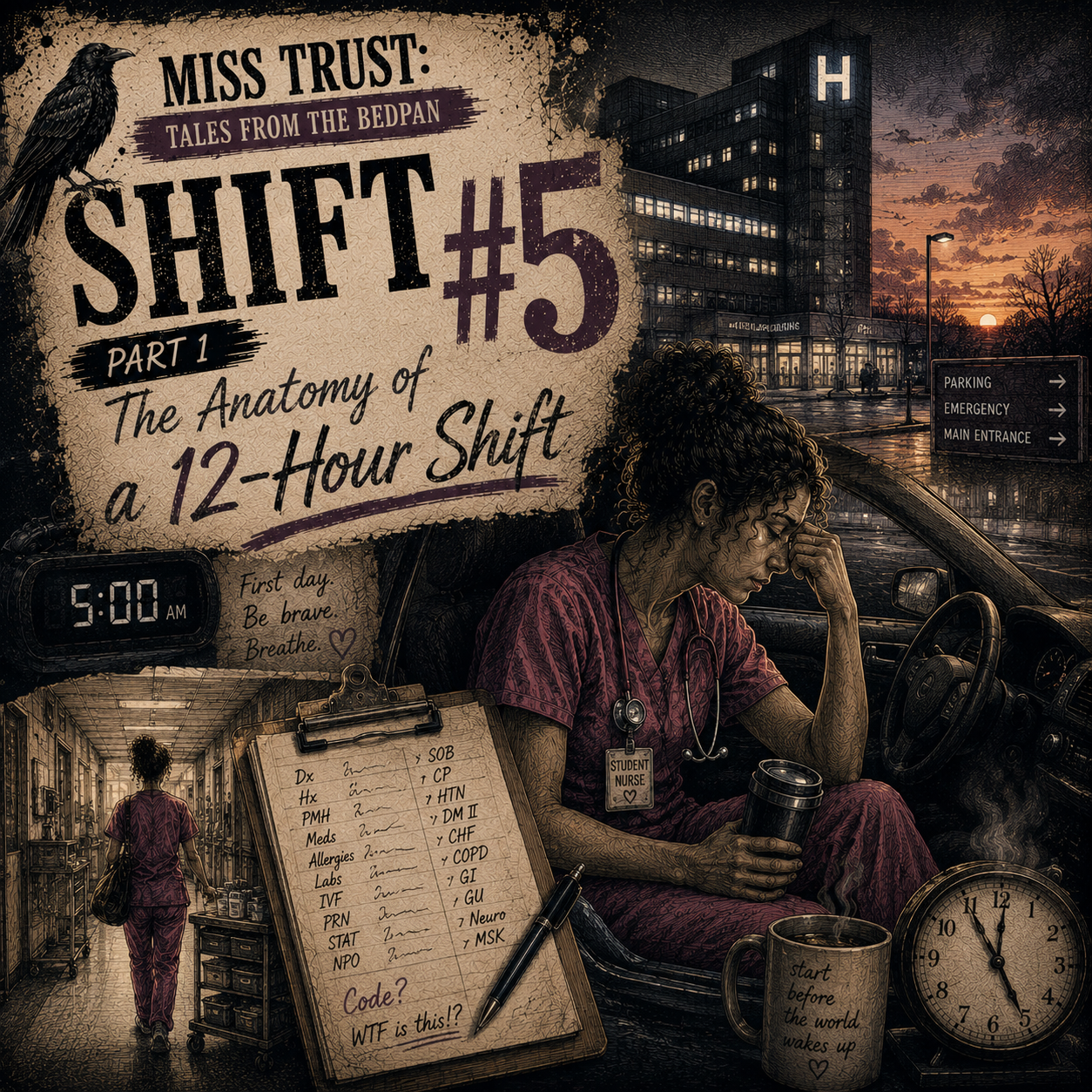
Shift #5: Part 1 – The Anatomy of a 12-Hour Shift
I woke up to the sound of my alarm at exactly 5:00 a.m. EXACTLY 5 A.M.! I know it was 5:00 a.m. because my body was screaming, “What the hell are you doing? Getting up at 5:00 a.m.? Are you sick!?” But here I was, up. Today was my very first hospital shift. Before I went to bed, I got all OCD and set multiple alarms out of fear I wouldn’t wake up … which didn’t really help. Thinking about that right before bed just meant I couldn’t fall asleep—because I was afraid I wouldn’t wake up! I’m still suffering from early-stage “nursing career syndrome.” Before every shift, I get anxious about not waking up on time. Then I can’t sleep. Then I wake up half-aware, followed by adrenaline surges once I hit the floor. That said, I am also still getting used to these 12-hour shifts. Is this how nurses work? Forever? Is this forever? Nurses start the day before the sun rises and usually end long after it sets. You can’t do anything before your shift, and you’re way too tired to do anything after! All I can do is sleep… or try to sleep, I mean, because, yeah, that whole fear of not waking up kicks back in.
Last night, I laid awake in bed thinking about all of this. Then I realized — it was 2 a.m.!? Why am I thinking about this now!? Ack! I fell asleep for a couple of hours, then woke up again… not enough time to go back to sleep, too early to get out of my warm bed. As I absorbed all the warmth of my comfy bed, I wondered how the day would unfold. Would the 12 hours fly by, or would it feel like the longest shift of my life?
Too much thinking. WAY too much thinking. I pulled myself out of bed and began the slow, deliberate art of getting ready. I made the conscious decision to wear my hot pink scrubs—a simple but important detail to boost my confidence and make a good impression on the nurses, the patients … really, everyone I was going to meet today. And while my fashion choices helped my confidence, they didn’t do much to help my main concern—I was desperate to make a good first impression on my preceptor.
LIKE ME, PLEASE.
More than anything, I hoped she’d be excited to have a student and would make the next three weeks a valuable learning experience for me.
I was so nervous.
I got in my car and drove to the hospital. Cold and pitch-black outside. Alone. No one was even on the road. Oh, the realities of this profession. We start work so early, the sun isn’t even awake! I was starting my day while the rest of the world slept. I bet all of my neighbours were still fast asleep. I knew for sure none of my roommates were awake this early.
I gave myself plenty of time to get to the hospital, maybe too much time. I arrived at the hospital so early, that I had to wait in my car for a bit and which made me focus even more on my nervousness and anxiety. Would I puke? Would I feel better if I puke? Probably not … plus, imagine someone seeing me puking … on my first day! Ha. No, I couldn’t puke. I forced myself to swallow. Coaching myself, sitting in the dark in my car, to breathe through my nose and out through my mouth. It helped; I felt a bit better—at least until it was time to leave the safety of my car and head into the unknown.
From the comforts of my car, the hospital looked so intimidating, especially compared to my last placement at the small long-term care centre. That place seemed tiny in comparison to this place. I was freaking out! I was freaking myself out! I didn’t even know where or how to pay for parking. And to make matters worse, I could barely read any of the signs, it was so dark outside. Thankfully, I found someone to ask and figured it out. They definitely could read my ‘puke-pondering’ mind!
I needed to calm down. It was my first day, for crying out loud! Wait… this is normal. It’s my first day… but still, calm down! With some self-soothing and some fetal-like rocking, I built up the courage to walk inside the hospital, find my floor, and meet my preceptor.
Finding my floor was easy, and with a little looking and a few meek inquiries, I found my preceptor. I didn’t know what to expect. She introduced herself and, without any pleasantries, immediately handed me a sheet of paper with our patient assignments. I stared at the sheet for a second. It was like seeing a map written in ancient Sumerian. “WTF is this!?” I thought. I was hesitant to ask questions out loud because everyone knows student nurses are expected to have full comprehension of Sumerian, right? Ugh! I didn’t want to seem incompetent, at least not yet. But seriously, I had no idea what anything on that sheet meant.
She had photocopied her worksheet, which also included her notes, abbreviations, short forms, and what appeared to be a secret code that only a codebreaker could decipher. Dammit! I didn’t know what any of it meant. We had learned about medical jargon in class, and how we should avoid using it with patients and in our charting. Yet in that moment, I felt like a child, completely lost in a strange and foreign language.
With time, I guessed I’d figure it out. I’d probably learn the different abbreviations and what those short forms meant. It would come with practice, of course, through repetition, receiving and giving reports. Eventually, it would all make sense … but that didn’t help me in the moment.
On my first day, I felt like I was being thrown into the fire … all over again. There wasn’t really an orientation. I met my preceptor right when the shift started at 7:00 a.m. and jumped into report. Then off to wake the patients, chart vitals, and give morning medications. I felt like I was in everyone’s way. I was probably overthinking. I do that — overthink. I’m doing it now.
I wondered if my preceptor even wanted a student. I wasn’t sure. It didn’t exactly seem like she did. I hoped she didn’t find me annoying. I can be annoying. I took a virtual knee. I settled myself down. I was there to learn—trying to observe everything my preceptor did to get the best learning experience possible. I had to do this, I thought, but be cool about it. I needed to stay on her good side and not be a burden. I spent the morning trying to literally be her shadow— there, watching, learning, but not in the way. I quickly noticed all of the nurses had their own groove, moving swiftly through the morning activities and checking off tasks with ease. I observed as much as I could, asked questions when possible, and found small ways to help.
Even though most of what I was doing was observing, for the first time, I really felt like a real nurse. By the time I checked the clock, three hours had already flown by. Caught up in the fast pace of the hospital, time moved quickly. This was nothing like working in long-term care; there was always something to do. Always!
Halfway through the shift, I took my second break. It was my lunch break. I was so excited to finally sit down. My legs and feet were in unbearable pain. They ached so much. How do nurses keep doing this day after day? How do they run around for 12 hours straight? I could only hope I’d get used to it. Maybe I needed better shoes? I definitely needed better shoes.
The day went by much faster than I anticipated. Twelve hours is a long time, literally half of a day! Before this, I think the longest shift I’d ever done was eight hours. And it was nothing like nursing; it was completely different. I was a restaurant hostess. Definitely calmer and more predictable than a hospital. I spent most of my shifts standing in the same spot at the front, greeting guests. Here, in the hospital, I was a spinning top! In one shift, I turned every corner, stepped into countless rooms, and never once stood still. This job keeps you on your toes—answering call bells, giving meds, and doing a dozen other things that need to be done throughout the day. It was exhausting, but I was learning a lot.
Toward the end of my shift, around 5:00 p.m., my preceptor and I were preparing to give evening medications. To my surprise, she asked if I wanted to administer them. Eager to learn and get involved, I grabbed our Workstation on Wheels (or WOW, as we call it) and entered the patient’s room. It felt surreal to be doing this in a hospital for the first time. I had practiced administering medications so many times in labs and simulations, on mannequins or pretend patients. Now, I was really doing it. I ran through all the steps: introduce myself, scan the patient’s wristband, and set up at the WOW, also triple-check everything before scanning and prepping the meds. It was so cool to do something like this for real, for the first time.
As I left the hospital that day, I felt a wave of relief that my first shift was finally over. It wasn’t as bad as I thought! In fact, it turned out to be a lot more manageable than I expected. I learned so much, and the day flew by faster than I could ever have imagined. And, in 12 short hours, I’d be back to do it all again.