
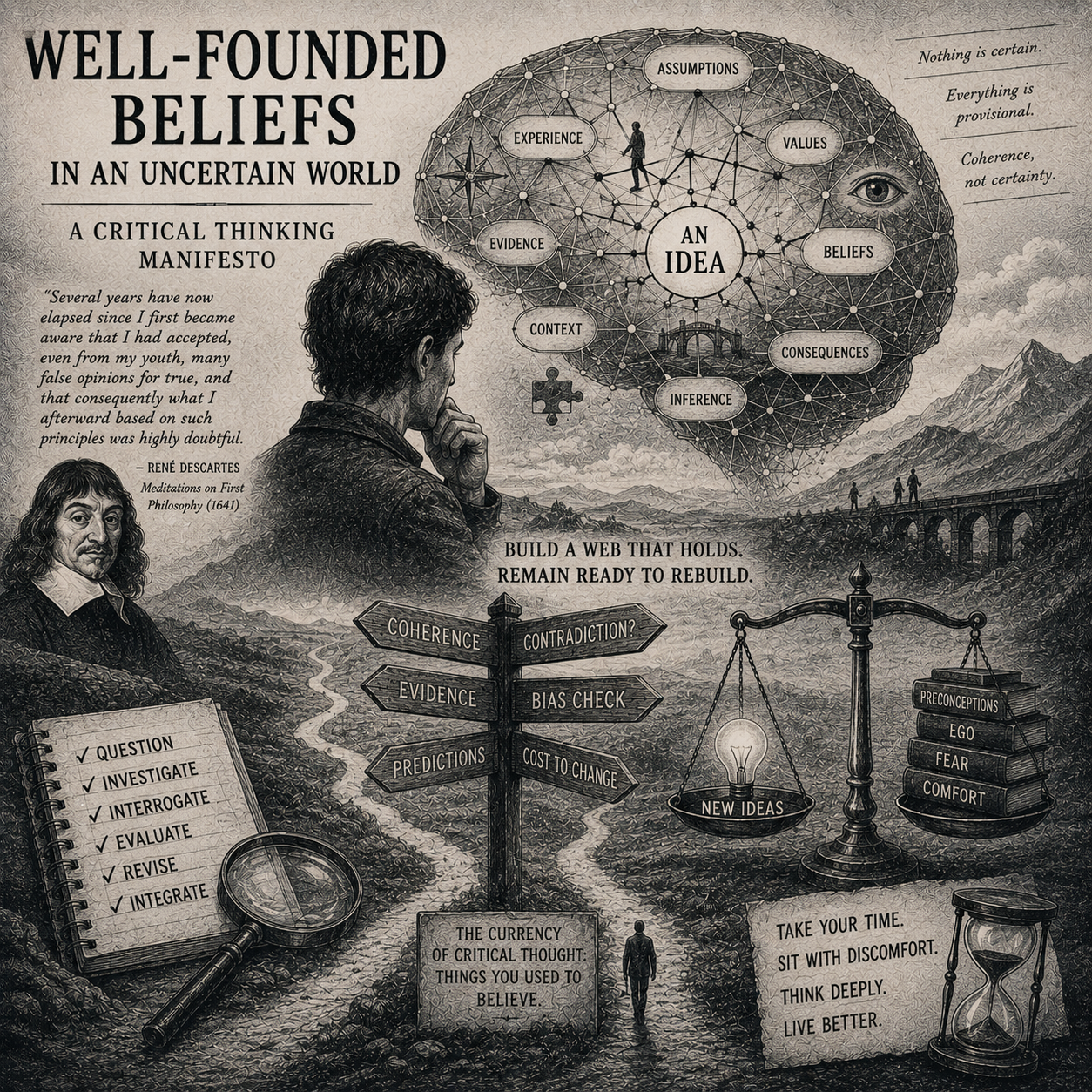
“Several years have now elapsed since I first became aware that I had accepted, even from my youth, many false opinions for true, and that consequently what I afterward based on such principles was highly doubtful.” – René Descartes, Meditations on First Philosophy (1641)
Since Miss Trust launched in 2024, we have been slowly exploring the idea of what it means to be a capable critical thinker in this era of infinite information and ever-growing dogmatic divide. We’ve talked about the very real harm that occurs when experts are ignored. We’ve talked about the harm that also occurs when experts are trusted too readily or too completely. And we’ve talked about how inescapably flawed our system for minting experts is in the first place.
We’ve talked about the perils of rampant misinformation, and the reasons even the smartest of us can sometimes be prone to falling for it. We’ve talked about the ways in which even the most obvious load of bullshit can sometimes hide things that we will only retrospectively recognize as important truths. And we’ve talked about how it’s fundamentally impossible to conclusively demonstrate that even a single thing is “true” in any absolute sense.
In short, over the course of half a dozen articles in this critical thinking series, we’ve presented at least a dozen takes on how one might sort through this mess and find a semblance of certainty in a set of well-founded beliefs, only to yank the rug away each time. You’d be forgiven for thinking it’s all a bit of a lost cause. But it doesn’t have to be.
We’ve alluded several times in this series to a strain of extreme philosophical skepticism descended from the works of René Descartes and David Hume. The problem of doubt goes all the way down, this skepticism argues. There is no purely rational basis for asserting the existence of the universe, let alone any facts about said universe. Without rehashing an entire Intro to Epistemology lecture here, suffice it to say that four centuries of brilliant philosophers have since tried to find a flaw in the skeptical argument, and they’ve more or less come up empty-handed[1]. And yet, we all—philosophers and laymen alike—continue to act as though the world exists. Because, when we’re hungry, we don’t need to prove the existence of a sandwich or our stomach to know that putting one into the other will better our circumstances.
Knowledge doesn’t have to be unassailable to be useful. Every work of science—and every act of our daily lives—is built on a web of ideas treated as though they were true. And it works. We build useful machines. We build civil societies. We survive.
Being a good critical thinker doesn’t mean only believing true things. It means only believing things that make sense. The standard we must hold ourselves to is one of coherence, not certainty. Because the web of ideas only continues to support our weight so long as each thing we treat as true can coexist without contradiction.
The critical thinking tools this series has provided should enable you to encounter a new idea and notice immediately that it is in fact its own entire web of dependent as thoughs. Every idea is. You should be able to look at this web from every angle, asking what other hidden beliefs are required to support the one on display, and what else follows from accepting the whole.
Work on developing the ability to see when an argument is incoherent, when it contains multiple ideas that contradict themselves. And when you do uncover these contradictions, ask yourself whether any part of the larger web can be salvaged. Because it can also be a mistake to reject out of hand a flawed idea easily fixed.
Then, when you are relatively confident that the idea is coherent within itself, ask yourself what it will cost you to integrate it into your own web of beliefs. It is easy, of course, to accept new truths that ask nothing of you. But you should never be too pleased with new information that conforms perfectly to what you already believe. This is how echo chambers are born. And echo chambers are anathema to critical thought.
Much more interesting are the self-coherent ideas that are incompatible with the things you have until now been treating as true. These are the ideas that infuriate because they seem to make sense, but you know they must be wrong because otherwise…
Treasure these ideas when you find them. They are your opportunities for growth. The flavour of skepticism that runs all the way to the foundation of the world shows its real value when it helps you understand that every strand in your own web, no matter how load-bearing it may seem, is provisional. You must give the “otherwise” a chance.
Look deep within your preconceptions and make an accounting of what would need to be cut away in order for you to accept this new idea as though it were true. Would the new web be stronger? Would it make more useful predictions about the world?
These are hard questions to ask, and harder ones to answer. Expect it to be a difficult and uncomfortable process. But know the effort is always worthwhile. There is a deep satisfaction in knowing you have given an idea every chance before setting it aside. And cutting an idea that no longer serves you from your web is a greater victory still.
Build yourself a vast and marvelous collection of things you used to believe. This, after all, is the real currency of critical thought.
With every article we offer at Miss Trust, we aim to expose you to new ideas. Ideas you may not have considered before. Hopefully, sometimes, these ideas make you uneasy because they don’t fit neatly with the things you already hold as true. Consider these ideas carefully. Take the ones that seem useful. Set aside the ones that don’t. Tug at every strand of your web for weakness.
But, most of all, take your time. Though we live in an era of hot takes and short memories, you are not in fact obligated to immediately accept or reject each new piece of information or line of reasoning as soon as you encounter it. If you take nothing else away from this series, we hope you will have become comfortable sitting with and exploring uncomfortable ideas. Critical thought is a process. Don’t rush it.
[1] If you want to check out some of the more interesting attempts to philosophically salvage the existence of the universe, I recommend looking into Immanuel Kant, Ludwig Wittgenstein, and G.E. Moore. You’ll find, however, that the most compelling anti-skeptical arguments give up on any idea of rigorous certainty very early in the ballgame.