
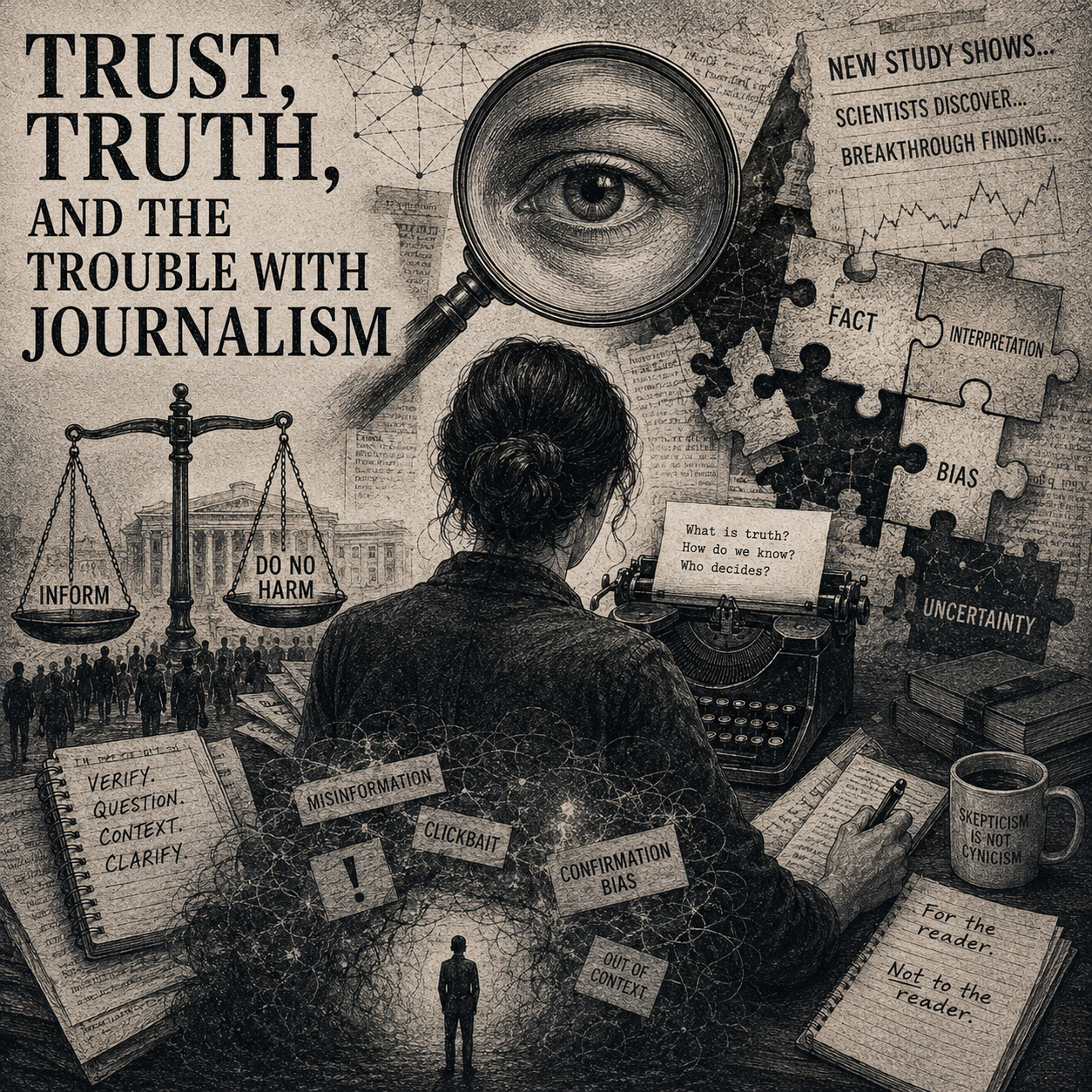
Trust, Truth, and the Trouble with Journalism
Journalism is hard. It’s not obvious that it should be, but it is. Fundamentally, journalism is simply a matter of collecting truths not everyone has access to and then communicating them accessibly. If you’ve been reading Miss Trust for a while, though, hopefully you are already asking questions like: What constitutes truth? How can you communicate it without changing it? How can I trust you?
Good questions. I wrestle with them every time I write. I wish everyone in the media lost as much sleep over them as I do. Because the best answers I have for you are not reassuring. Nobody knows. You can’t. You shouldn’t.
These are big problems for everyone in the truth business and everyone in the communication business. For my part, most of the journalism I do personally is in the world of science, particularly health science, and so I am especially attuned to the pitfalls inherent to this niche. And despite being a beat that’s not usually seen as especially high stakes, bad medical reporting can do significant and tangible harm, on both the individual and societal levels. Almost every health myth and misconception can be traced back to bad reporting, as can many of the larger points of contention around issues like vaccination.
So, when I am writing about health, I wear the responsibility of scientific accuracy heavily on my shoulders. I am thinking all the time about the many points of failure in the chain of information and communication that runs from the world to my source, from my source to me, and from me to the reader. I think of how fragile it is at every link.
Probably the most obvious point of failure—in the realm of science reporting at least—is from source to journalist. Specifically, there is always a risk that the information a scientist is trying to convey to a journalist won’t make it from one mind to the other intact.
When I am speaking with a researcher about their work, no matter how well informed I may be on the subject, there’s always a huge gulf between my own understanding and theirs. It can’t be otherwise. These people are experts, with PhDs and decades of experience. They are living and breathing this specialized knowledge every day. They understand their field in a way I never will. That’s precisely why I’m talking to them. But it also makes it very easy for them to say one thing and me to hear another.
This, at least, feels like something that can be controlled and mitigated. Most of these errors can be avoided—if the journalist is diligent—by verifying and re-verifying information before letting a piece go to print.
Much more insidious, is the failure point between the world and the source. When I’m dealing with an expert source, I have a responsibility to ensure I understand the information they’re saying to me, but also to interrogate their own basis for believing that information. It’s extraordinarily rare in my line of journalism that a source will actually try to deceive me. But we are all susceptible to unwarranted confidence, to blind spots, and to unconscious biases.
I should confess at this point that I didn’t go to journalism school. My educational background is in neuro and cognitive science. I snuck into a career in journalism through the back door. My science education does help me speak to doctors and scientists with more ease than some other journalists. But, of all the classes I took in my university career, it’s the lectures on epistemology and philosophy of science that I draw on most. Those classes inoculated me well against bold conclusions extrapolated from young data, which is too often the bread and butter of science journalists (and sometimes of scientists themselves). Those classes taught me a visceral wariness of a phrases like a “a new study shows” and “it’s been proven that” and especially “the scientific consensus is.” Which is not to say that I don’t trust science, but rather that my skepticism doesn’t go on hiatus just because someone with a PhD is speaking.
The entirety of scientific knowledge is a tangled interdependency of theories and hypotheses that have mostly worked well enough so far. The more threads that get added, the more stable the whole web seems, but when you tug on any new claim, you’ll often find at least one troubling weak point lurking underneath. A researcher who is telling me, for example, about a new finding related to serotonin and the implications this discovery has for depression is almost certainly conveying that information in good faith (and undeniably knows more about brain chemistry than I do). But, at the same time, I have a responsibility to understand that their research is taking place within a scientific paradigm that accepts the serotonin theory of depression, and that this theory itself is very much a subject of active debate[1].
It’s important also to understand that this is not a gotcha. This is necessarily how science works, and one research program is not invalidated just because it builds on another research program still in progress. As a journalist, though, it would be irresponsible for me to report on a finding without asking which assumptions it depends on.
But the failure point that troubles me most of all is the interface between me and the reader. Because, even when I am confident in the information I have received and in my understanding of it, great harm can be done by sharing it recklessly. Let me give you an example.
In the course of my work I sometimes find myself speaking to people suffering from extremely rare and life-threatening diseases. Often, when I ask what their first symptoms were, I’m told it was something like a persistent headache and a general fatigue that originally took them into the doctor’s office. I’ll then talk to a doctor who specializes in this rare disease and they’ll confirm that, yes, headaches and fatigue are common early symptoms. And yet, I need to think about what happens when I put that in the article. Because while the incidence of this disease might be literally be one in a million, the incidence of fatigue and headaches is, near as I can tell, one in one.
If my article causes anxiety in a hundred readers who become convinced they have a deadly disease they almost certainly don’t have, am I culpable for that? I think I am.
Of course, I also have a responsibility to share the true facts of this patient’s story, headaches, fatigue and all. And so I am very careful with my words. I quote the patient and include those early symptoms, but I also talk about the far more common conditions that can present identically. I talk about how this overlap can complicate and delay diagnosis. And I hope that it’s enough. I’m sure sometimes it isn’t.
No matter how careful I am though, I can’t control what happens once a story is out in the world. Some of the responsibility for reinforcing that last vital link in the chain does lie with the reader. Hard as it may be, every writer must eventually trust the reader to meet them halfway.
And so I do trust my readers. But, as I spill thousands upon thousands of words here on Miss Trust, extolling the virtues of critical thought, it has not escaped me that I am arguing clearly in favour of the reader not trusting me back. That’s not by accident. Because, though the vast majority of science journalism is done in good faith, mistakes do get made. Sometimes I’ll be the one to make them. My greatest hope is that, when that happens, the harm will be mitigated because you, the reader, will know the right questions to ask.
In this new series, Manufacturing Confusion, we’ll be taking a series of extended peeks behind the curtain of journalism. We’ll be looking at how this endeavour goes wrong and how it goes right. We’ll be shedding light—through example, anecdote, and analysis—on the challenges faced by those tasked with collecting, sorting, analyzing, and communicating that most precious and elusive commodity: truth(*definition TBD).
If seeing how the sausage is made shakes your faith in journalism, so be it. This was never the right venue for faith. Still, I personally believe there is room for a cautious optimism in the institution of journalism, even if that optimism must be erected upon a healthy foundation of skepticism. Don’t take my word for it though. Instead, follow us through the twists and turns of Manufacturing Confusion and decide for yourself.
[1] https://www.nature.com/articles/s41380-022-01661-0