
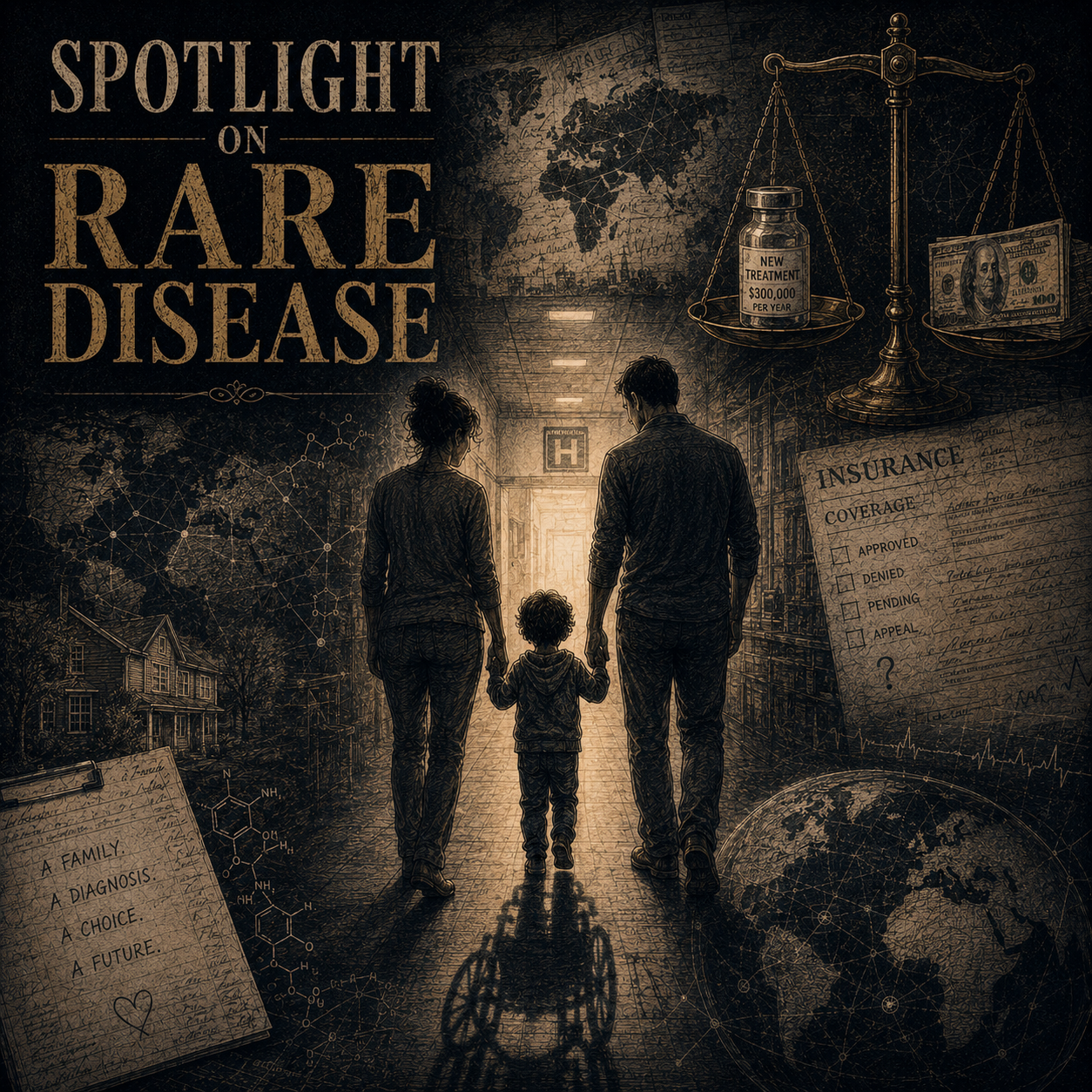
Spotlight on Rare Disease: How Well Do You Really Know Your Health Care System?
Every healthcare system in the world is flawed. But they’re all flawed in different ways. And those differences matter quite a lot. If only we could talk about them objectively.
Who should pay? Who should be prioritized? What should be the standard of care? How expensive is too expensive when a life is on the line?
These are hard questions and reasonable people can differ. But the conversations go nowhere when everything is talked about in the abstract and every imperfection is treated as a “gotcha.” Time and again, Model A is demonized into a caricature, and Model B is whitewashed as utopian. Then another commentator comes along with rose-coloured lenses for Model A and a litany of dystopian outcomes for Model B. And no one’s mind is changed.
But for the people actually dependent on these healthcare systems, things are not abstract at all. The difference between one imperfect model and another imperfect model is the difference between life and death for real people. It’s the difference between a little financial hardship and absolute destitution. It’s the difference between dignity and despair.
And so, in the interest of comparing like against like—and actually taking a careful look at the way these differences translate into outcomes—we invite you to join us in a tour of the world from the perspective of someone who really needs their healthcare system to work for them.
Allow us to introduce you to yourself.
You have done everything right and have managed to eke out a middle-class life for your family, even in these times of economic turmoil.
You are 35 years old, with a bachelor’s degree and a salaried job in your field that pays a bit more than the median plus health benefits. You are not sure how secure your job is however, and you’ve also been thinking you might need to change companies in order to continue advancing your career.
Your partner, also 35, works part-time and has simultaneously spent the last several years slowly starting a small business which has just begun to turn a profit. Their total income is about half of yours with no benefits, but they are optimistic about the future income potential of their small business.
You’ve intentionally chosen to live in a lower cost of living area, and you recently purchased your first home. You are able to carry the mortgage, but it has made finances somewhat tight. You have an emergency savings account that could see you through about six months, but otherwise most of your wealth is tied up in the house. Your parents, siblings, and extended family are also making ends meet, but none are much more financially secure than you are.
You have an 8-year-old child who excels in school and participates in a number of extracurriculars, including sports and music. These activities consume a big chunk of your spare time and discretionary budget, but it’s worth it.
You also have a 2-year-old child who is happy and active and has been meeting all their milestones. Just after their second birthday, however, your younger child began to have minor muscle spasms and, after a lengthy series of tests, was diagnosed with a rare (~1 in 200,000) degenerative neuromuscular condition [1].
This condition will see your child slowly lose the ability to walk, speak, feed themselves, and eventually breathe. The doctors have said that you can expect your child to be in a wheelchair by age 5, and to pass away before their 20th birthday. Your child will need full-time care at home for their entire life. Physiotherapy, assistive equipment, and other baseline costs of managing this disease may or may not be covered by insurance.
There is, however, a new and effective treatment for this condition. It does not cure the disease, but it slows progression so dramatically that patients who respond well to the drug are expected to retain some mobility into adulthood and live into their 40s or 50s, perhaps even longer if this treatment buys them time for newer, innovative medications to be developed.
Outcomes are dramatically improved the sooner treatment is started. Progression of the disease is not reversed by treatment, only slowed. Some countries and some insurers are arguing that children able to start treatment before the age of two should be prioritized for coverage as this group statistically has the most positive outcomes.
This treatment costs $300,000 USD per year. Patients must stay on the treatment their whole lives.
In this series, we will explore what the future of your family may look like, depending on what the medical and health insurance landscape looks like in the country where you live.
Will your child get the treatment they need? How hard will you have to fight for it? How much support will your family get? How much will you have to sacrifice? Will you be bankrupted in the process?
Month by month, we will be visiting different health care jurisdictions and performing a deep dive into the outcomes you could expect if that were your home.
First stop, the United States of America.
NOTE: You can bookmark this post and return to it at any time for a list of links to each geographical analysis published to date.
[1] This particular disease is fictional, but it bears a close resemblance (in both prognosis and treatment) to Type II Spinal Muscular Atrophy.