
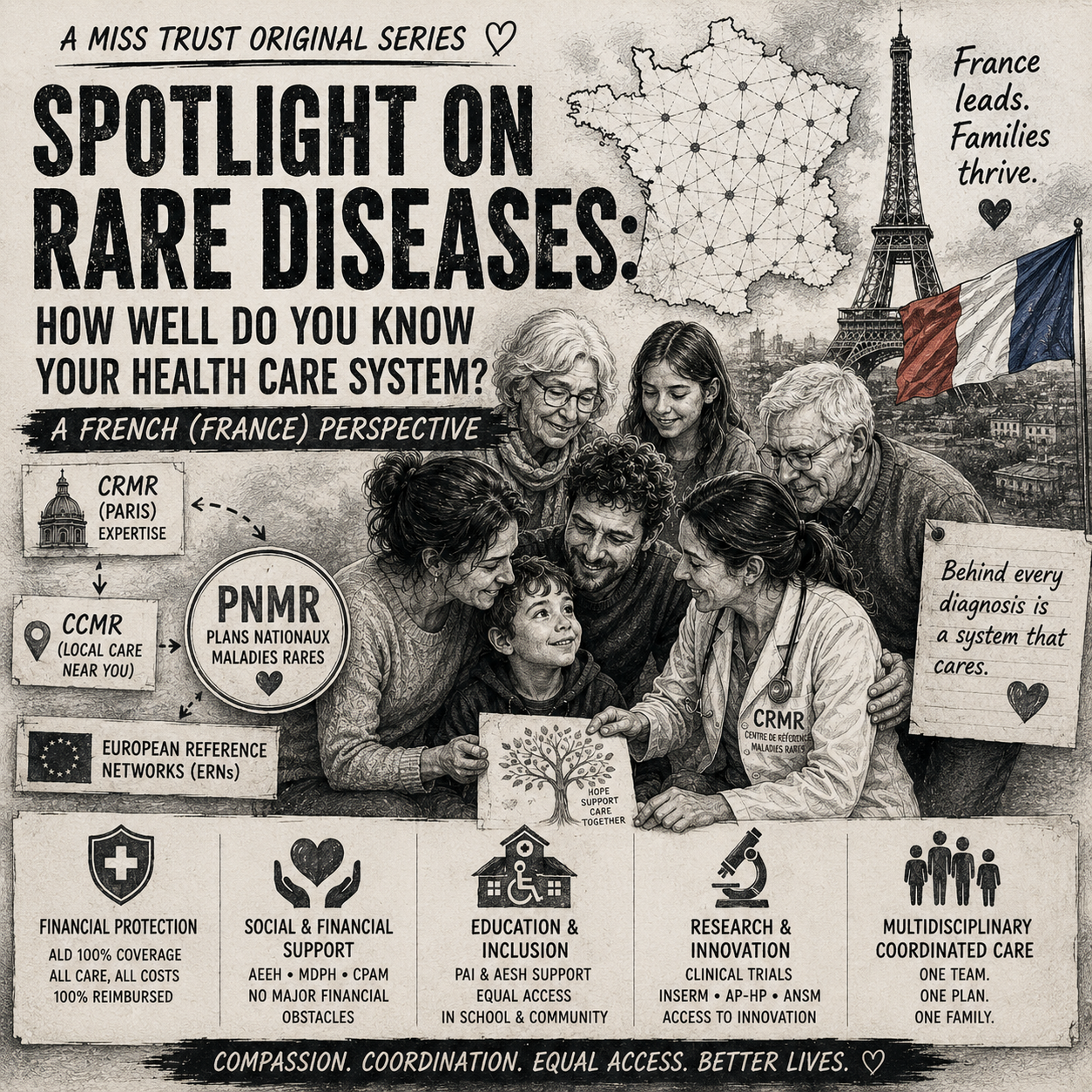
Spotlight on Rare Diseases: How Well Do You Know Your Health Care System? A French (France) Perspective
Read the introduction to this series for context.
Overview
Your family resides in France and is confronted with the daily realities of caring for a child with a rare neurodegenerative condition. What could have been an overwhelming and isolating experience elsewhere becomes, in France, a coordinated and compassionate pathway through one of the world’s most comprehensive rare-disease systems.
Through the Plans Nationaux Maladies Rares (PNMR) and integration with the European Reference Networks (ERNs), France ensures timely diagnosis, coordinated expert care, comprehensive financial protection, and sustained psychosocial support.
Early Symptoms and Rapid Referral
At age two your child began to show subtle but worrying signs – a slight tremor when colouring and drawing, unsteady balance, and slower speech. Concerned, you take your child to their médecin traitant (family doctor), failing to immediately recognize what the symptoms could indicate, refers for additional testing for rarer neurological disorders.
Under PNMR3 (2018–2023), general practitioners are trained to spot such early signs and refer patients without delay to specialized centers. Within weeks, your family receives an appointment at the nearest hospital – avoiding the prolonged ‘diagnostic wandering’ that many families endure in countries like Canada and the United States.
Specialist Evaluation and Genetic Diagnosis
At the hospital, a pediatric neurology team begins a full diagnostic workup. Their initial findings point to a neurodegenerative disorder. Immediately, your child is referred to the Centre de Référence Maladies Rares (CRMR) in Paris, a national hub specializing in neurogenetic diseases. Although the hub is located in Paris, care and any treatment is performed at your local hospital. Your family is not required to travel away from your community for care and/or treatment.
Through collaboration between the CRMR and your family’s local Centre de Compétence (CCMR), genomic analysis is launched under the Plan France Médecine Génomique 2025, with support from INSERM (National Institute of Health and Medical Research).
Within four months, whole-exome sequencing confirms a rare progressive neurodegenerative condition – giving your family both a name for your child’s illness and a path forward.
Coordinated Multidisciplinary Care
Following diagnosis, the CCMR becomes your family’s central coordination hub. A multidisciplinary team is formed – a hallmark of PNMR3’s parcours de soins coordonné (coordinated care pathway).
The team includes:
• Pediatric neurologist (medical lead)
• Physiotherapist and occupational therapist (motor support)
• Speech therapist (language and swallowing rehabilitation)
• Psychologist (psychosocial and family support)
• Hospital social worker (financial and administrative guidance)
Care coordination extends between your community (CCMR) and Paris (CRMR), supported by teleconsultations and shared digital records. The European Reference Network for Neurological Disorders (ERN-RND) adds an international dimension, offering access to cross-border expertise. Thanks to the benefits of the European Union (EU) your child has access to expertise and resources from all EU member states, if needed.
Financial Protection and Social Assistance
Upon confirmation of the diagnosis, your child’s condition is classified as an Affection de Longue Durée (ALD) (Long-Term Illness) under France’s national health insurance system (Assurance Maladie). This ensures 100% reimbursement for all disease-related costs – consultations, therapies, medications, and travel. Even if costs are incurred outside of France, but within the EU, costs are covered at 100%.
In addition, the hospital social worker guides your family through complementary support programs, including:
- Allocation d’Éducation de l’Enfant Handicapé (AEEH) (Allowance for the Education of a Disabled Child)
- Maison Départementale des Personnes Handicapées (MDPH) (Departmental Disability Services) for specialized education and transport
- Coordination with Caisse Primaire d’Assurance Maladie (CPAM) for administrative support
Simply put, your family experiences no major financial obstacles as a result of this situation. The PNMR’s promise of equal access to care and diagnosis applies to every family. There may be certain services not available through the public model but through employment, most permenant/temporary employees are enrolled in a Mutuelle or Assurance santé complémentaire. This is the private health insurance most people in France have in addition to the public health system (Assurance Maladie). It reimburses the part of medical costs not covered by the government (for example, additional care services and equipment).
Education, Inclusion, and Community Integration
Through coordination with the MDPH, your child’s school has developed a Projet d’Accueil Individualisé (PAI) (Individualized Care Plan) and assigned an AESH (Support Assistant for Students with Disabilities).
Your child’s teachers are provided training from the hospital’s education liaison team on neurodegenerative disorders and inclusive teaching strategies. Psychological support is also extended to classmates, helping to reduce stigma and build understanding within your child’s school community.
Research Participation and Access to Innovation
As a registered family within the national rare-disease network, the Centre de Référence Maladies Rares (CRMR) may invite you to take part in clinical trials coordinated by INSERM and Assistance Publique–Hôpitaux de Paris (AP-HP). All studies are approved by the Agence Nationale de Sécurité du Médicament (ANSM), and if selected, your travel and related expenses would be fully covered through the Affection de Longue Durée (ALD) system and hospital research grants.
In addition, your family is listed in Orphanet — the international rare-disease database founded in France — and connected with Alliance Maladies Rares (the National Alliance for Rare Diseases) enabling you to access peer support, advocacy resources, and community networks.
Long-Term Management and Follow-Up
As your child’s condition progresses, the care plan is quickly adapted to meet your family’s changing needs. Regular multidisciplinary reviews are aligned with PNMR3’s model for suivi coordonné (coordinated follow-up), ensuring that all therapeutic, psychological, and educational supports evolve with your child’s changing needs.
Telemedicine reduces the need for hospital visits, while home physiotherapy and respite care help maintain family balance. Psychological services from the hospital’s service de pédopsychiatrie (child psychiatry department) provide long-term emotional support to you, your spouse, and any other family member involved in your child’s care (e.g., grandparents, aunts/uncles, siblings).
Conclusion
While the eventual outcome may be the same anywhere in the world, your family’s journey exemplifies how France’s rare-disease ecosystem offers not only medical care, but also security, inclusion, and dignity. Through the PNMR and ERN frameworks, a rare, life-altering diagnosis becomes a structured, supported experience grounded in expertise, research, and compassion.
While France’s rare-disease system offers exceptional structure and support, families still face practical and emotional challenges. Navigating multiple agencies for benefits and educational accommodations can be complex, and access to expert centers often requires travel from rural areas, albeit travel costs would be covered to and from the treating center. Wait times for specialists and therapies may add to the strain, despite strong national coordination. Emotionally, parents can experience fatigue as they balance administrative demands with the realities of a chronic, often incurable condition. Overall, the system functions impressively, but for families, it can still feel like a demanding journey through a compassionate yet intricate network.