
If you’ve been a parent of a school-aged child at any point in the last twenty years, you’ve probably had occasion to be frustrated with school lunch policies — No peanut butter sandwiches, no granola bars unless they’ve got a nut-free stamp of approval. Some schools even forbid all home-made baked goods.
One the one hand, you understand that nut allergies are serious, and you certainly don’t want to be the reason one of your child’s classmates goes into anaphylactic shock. But, on the other hand, you have to ask how we got here. It wasn’t that long ago that PB&J was a school lunch mainstay and nut allergies weren’t even on the average parent’s radar. Where were all these kids with life-threatening peanut allergies a few decades ago? How did they survive the no-rules free-for-all of a 90s school lunch?
Well, the short answer is that not all of them did. Between 1994 and 1999, there were eight documented cases of children dying in the US after exposure to peanuts (and another twelve deaths in adults)[1]. And these are just the cases that were reported to the American Academy of Allergy, Asthma, and Immunology. It’s all but certain that there were other unreported deaths, especially given that there was very little public awareness about food allergies at the time. In fact, it was widespread media coverage of several of these tragedies that kicked off the “peanut panic” of the late 90s[2], charting a direct course to bans on peanuts in schools and other public settings.
Looking a little closer, however, only one of these deaths was actually tied to peanut exposure in a school setting. The question of to what degree a society of hundreds of millions should be expected to change their behaviour to prevent a couple of deaths per decade is a genuinely interesting one (perhaps especially so in the wake of COVID). But there’s something even more interesting at play. Though peanut allergy deaths were always rare (and have slowly declined in recent decades), the prevalence of peanut allergies has gone up dramatically[3]. And it’s not just that allergies are being diagnosed more consistently (though that’s also happening). The data clearly shows that the percentage of kids with potentially deadly peanut allergies has more than tripled since 1997.
So we are, in fact, worrying about peanut allergies more because more kids have peanut allergies. But here’s the kicker. It’s true the other way around as well. More kids have peanut allergies because we’re worrying about peanut allergies more.
Before about 1990, the medical community was largely silent on the idea of preventing food allergies in children. Allergies were something you worried about when they reared their head, not before. With the mounting concern about peanut allergies in children over the course of the 90s, doctors in multiple countries slowly began to suggest cutting potentially allergenic foods from the diets of infants and young children, hypothesizing that early exposure to an immature immune system could cause allergies to develop. This line of thinking culminated, in the year 2000, with an official recommendation from the American Academy of Pediatricians advising a complete avoidance of peanut products until three years of age, with health authorities in Canada, the UK, Australia, and Europe issuing similar guidelines. For the most part, these recommendations only specifically applied to families with a history of serious food allergies. But, in practise, the message heard by physicians and parents alike was: Keep peanuts away from babies.
This theory of allergy development, however, was untested. There was simply no high-quality population-level evidence one way or the other. So, while the first large studies began to get underway, the advice veered towards what was believed to be the position of maximum caution. With catastrophic results.
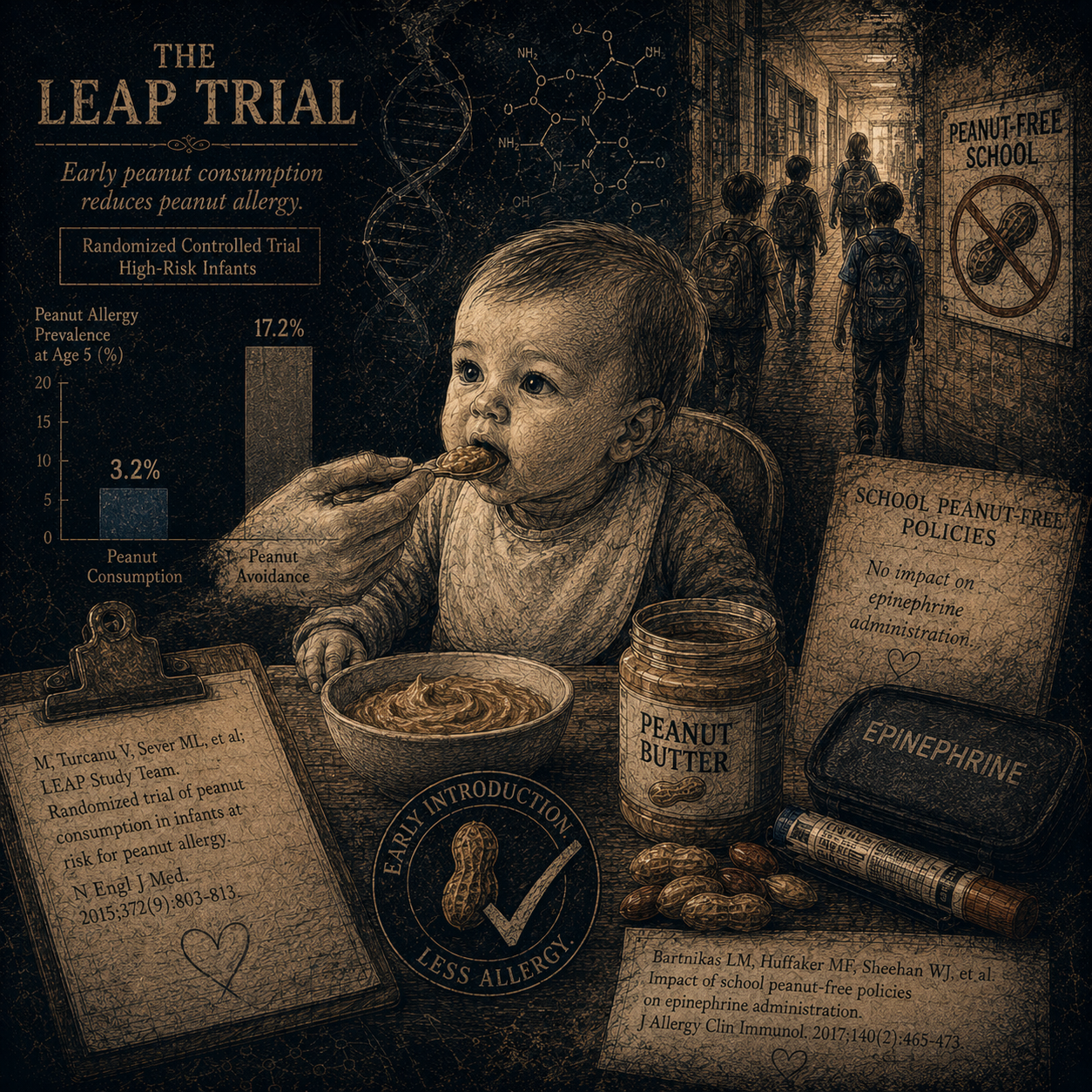
By 2008, the trend towards a new epidemic of food allergies was clear, and health authorities began to backpedal on their recommendations against exposing infants to peanuts and other allergens. Then, in 2015, the landmark LEAP study[4], published in the New England Journal of Medicine, showed unequivocally that exposing kids to peanuts at an early age didn’t increase the risk of peanut allergies, it dramatically lowered it. The earlier position of maximum caution was turned on its head.
Very quickly, new guidance was pushed worldwide. Peanuts were back on the menu (or rather peanut products, since whole peanuts are a choking hazard). But the damage was already done. Important science is still in progress, and we’re a long way from having a complete causal model of food allergies, but there’s little doubt that the years we spent keeping our kids away from peanuts played a part in the massive peanut allergy spike of recent decades.
This whole saga is a poignant reminder of why research and data are so critical. Sometimes the course of action that intuitively seems best is, in fact, the exact opposite of what we should be doing. This story also highlights why it is so important for us to be ready to change our beliefs, sometimes dramatically, when new data becomes available. After the revelations of the LEAP study, many parents (and some physicians) clung fast to the old model for far too long. Even to this day, parents following the current guidance are sometimes met with horror from older folks who remember the guidance of decades past.
So where does that leave us? Well, for one thing, if you have a child between the ages of six months and three years, you should be following the most up-to-date guidance on when to introduce potential allergens, and you should also be ready for the possibility of that guidance changing at any time. Critical thinking means staying nimble. And humble. We should not look too ungenerously on the parents and doctors who kept a generation of children away from peanuts, even if that overabundance of caution helped spark an allergy epidemic. They were acting on the best information available at the time, and we should all strive to do the same.
As for the school lunch thing, that’s a much more complicated question. While the current advice is that children—even children at a higher risk of food allergies—be exposed to peanuts early, a peanut-free school doesn’t prevent any child from consuming peanut products at home. And, for children who have already developed an allergy, keeping away from peanuts is indeed a matter of life and death. That said, evidence is increasingly suggesting that blanket bans on peanuts in school settings don’t actually prevent anaphylactic events compared to basic precautions like hand washing, allergy training for school staff, and safety measures for kids with known allergies[5]. Over time, perhaps we can expect a rollback of peanut bans at schools as well. But, in the meantime, if your kid’s school is peanut-free, it shouldn’t take a peer-reviewed study to tell you that sending them a PB&J for lunch is a dick move.
[1]. Bock SA, Muñoz-Furlong A, Sampson HA. Fatalities due to anaphylactic reactions to foods. J Allergy Clin Immunol. 2001 Jan;107(1):191-3. doi: 10.1067/mai.2001.112031. PMID: 11150011.
[2]. Waggoner MR. Parsing the peanut panic: the social life of a contested food allergy epidemic. Soc Sci Med. 2013 Aug;90:49-55. doi: 10.1016/j.socscimed.2013.04.031. Epub 2013 May 6. PMID: 23746608; PMCID: PMC3700803.
[3]. Nowak-Wegrzyn A, Hass SL, Donelson SM, Robison D, Cameron A, Etschmaier M, Duhig A, McCann WA. The Peanut Allergy Burden Study: Impact on the quality of life of patients and caregivers. World Allergy Organ J. 2021 Feb 15;14(2):100512. doi: 10.1016/j.waojou.2021.100512. PMID: 33664934; PMCID: PMC7898168.
[4]. Du Toit G, Roberts G, Sayre PH, Bahnson HT, Radulovic S, Santos AF, Brough HA, Phippard D, Basting M, Feeney M, Turcanu V, Sever ML, Gomez Lorenzo M, Plaut M, Lack G; LEAP Study Team. Randomized trial of peanut consumption in infants at risk for peanut allergy. N Engl J Med. 2015 Feb 26;372(9):803-13. doi: 10.1056/NEJMoa1414850. Epub 2015 Feb 23. Erratum in: N Engl J Med. 2016 Jul 28;375(4):398. doi: 10.1056/NEJMx150044. PMID: 25705822; PMCID: PMC4416404.
[5]. Bartnikas LM, Huffaker MF, Sheehan WJ, Kanchongkittiphon W, Petty CR, Leibowitz R, Hauptman M, Young MC, Phipatanakul W. Impact of school peanut-free policies on epinephrine administration. J Allergy Clin Immunol. 2017 Aug;140(2):465-473. doi: 10.1016/j.jaci.2017.01.040. Epub 2017 Mar 25. PMID: 28347736; PMCID: PMC5546995.