
Highly improbable outcomes can hold an outsized importance in our mind. It’s a quirk of human psychology to which few of us are immune. We go on a beach holiday and fret about shark attacks, without any attempt to do the math on a hundred or so shark bites per year worldwide versus literally billions of visits to beaches. We lie awake in bed developing contingency plans for home invasions, for natural disasters, for plane hijackings. Taken to the extreme, this catastrophizing about remote possibilities can blossom into debilitating anxiety. But, at the same time, there is a sense to it. Any given rare occurrence is by definition exceedingly unlikely on any given day. But we see a lot of days, so the chance of something rare eventually happening to us rises over time to a near certainty.
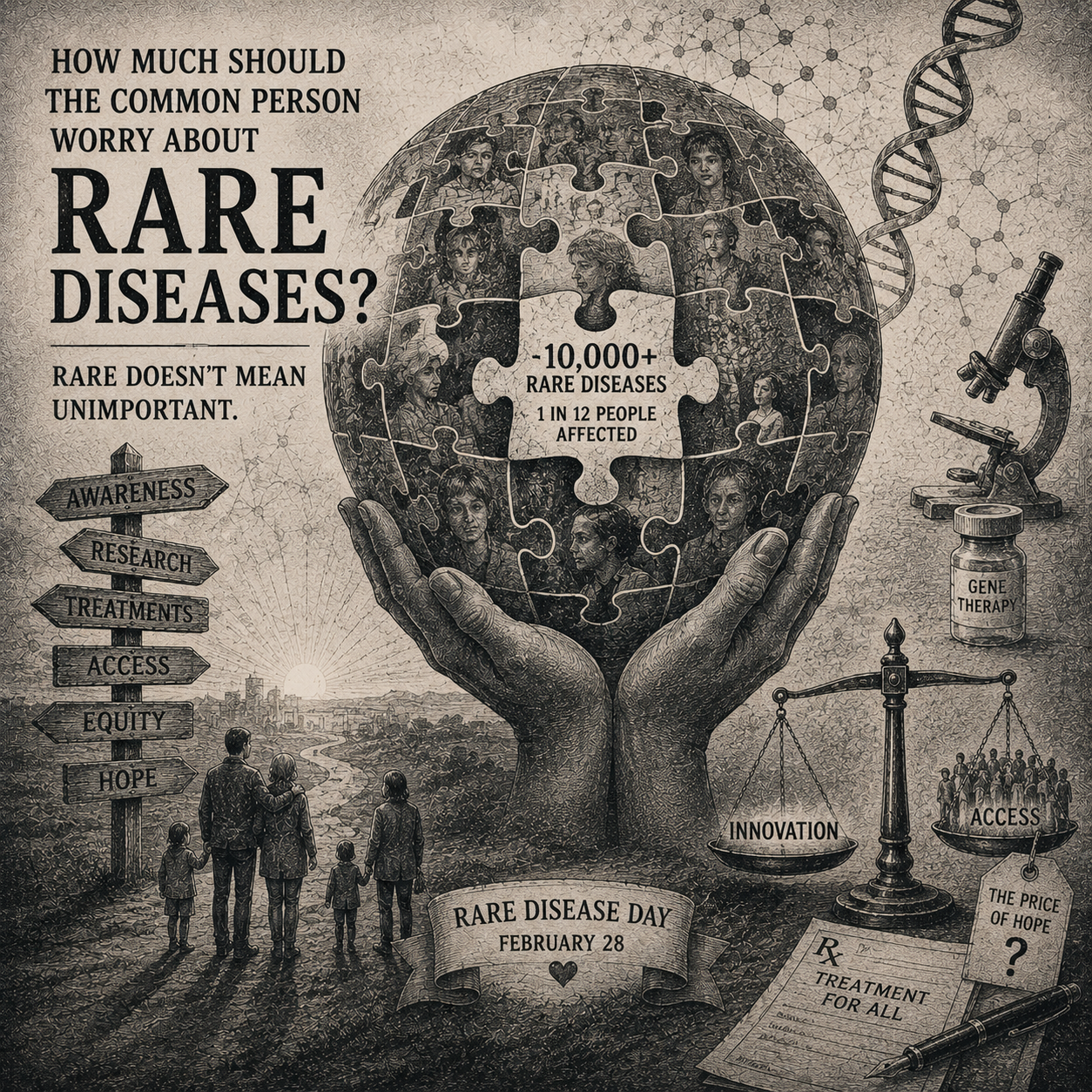
February 28th is Rare Disease Day. The threshold of what exactly counts as a “rare” disease varies from country to country, but the definitions roughly converge on illnesses that affect fewer than one person in two thousand. One in two thousand isn’t exactly shark attack unlikely, but it’s rare enough that you probably shouldn’t devote too much time to worrying about developing any one of these diseases. The trick, of course, is that there’s a lot more than one of them. In fact, more than ten thousand diseases that meet this criteria have been identified so far, and that number grows every year. Advances in diagnostics and genetic testing have us regularly discovering that conditions once thought to be variations of better-known illnesses are instead their own thing. The Canadian Rare Disease Network now estimates that, considering rare diseases as a whole, as many as one in twelve Canadians are affected. That same math should more or less apply globally.
The good news is that the same kinds of innovation that are helping us identify new rare diseases are also, for the first time, allowing us to develop targeted treatments. Technologies like CRISPR, AAV gene therapy, CAR-T cell therapy, and others are quickly changing the shape of clinical research in all areas of medicine, but especially in the world of rare diseases. Many conditions that had long been considered “orphan diseases”—because their rarity meant little active research was being funded—are now seeing unprecedented hope for effective treatment.
Of course, not all rare diseases are amenable to these technologies, and a great many diseases are still waiting for the preliminary investigative research into cause and mechanism that must precede any attempt at developing a targeted therapy. And even when a new therapy is developed for a rare disease, the very small number of patients often means that prices are astronomical as pharmaceutical companies attempt to recoup research costs[1], causing significant access problems in both public-payer and private-payer healthcare systems[2].
So, this Rare Disease Day, remember that rare diseases are more common than the name suggests. And, when you see a story about a groundbreaking new treatment for any given rare disease, know this does not mean the war is won. For decades, rare disease communities have been fighting for awareness, for support, for research. Those fights continue, though progress is being made. In the coming years, however, we can expect the fight to shift towards obtaining equal access as innovative treatments become available for more and more rare diseases without any obvious path towards individual affordability. This is likely to be the hardest battle yet and winning it may require a radical reinvention of how we think about treatments and deliver care in general. In 2026, rare disease is an everyone issue.
[1] It is easy to get angry at pharma companies when they are trying to charge hundreds of thousands of dollars per year for a life-saving treatment represents the only hope for a rare disease patient. But, at the same time, it’s hard to see how such treatments would ever be developed in the first place if they couldn’t be priced to recoup costs. This is going to be an increasingly large problem with no easy solutions, and every healthcare system is going to have to reckon with it very soon. In the meantime, at least, most pharma companies have compassionate access programs.
[2] For examples of how this might play out under different healthcare systems in different jurisdictions, be sure to check out our ongoing “Spotlight on Rare Diseases” series.