
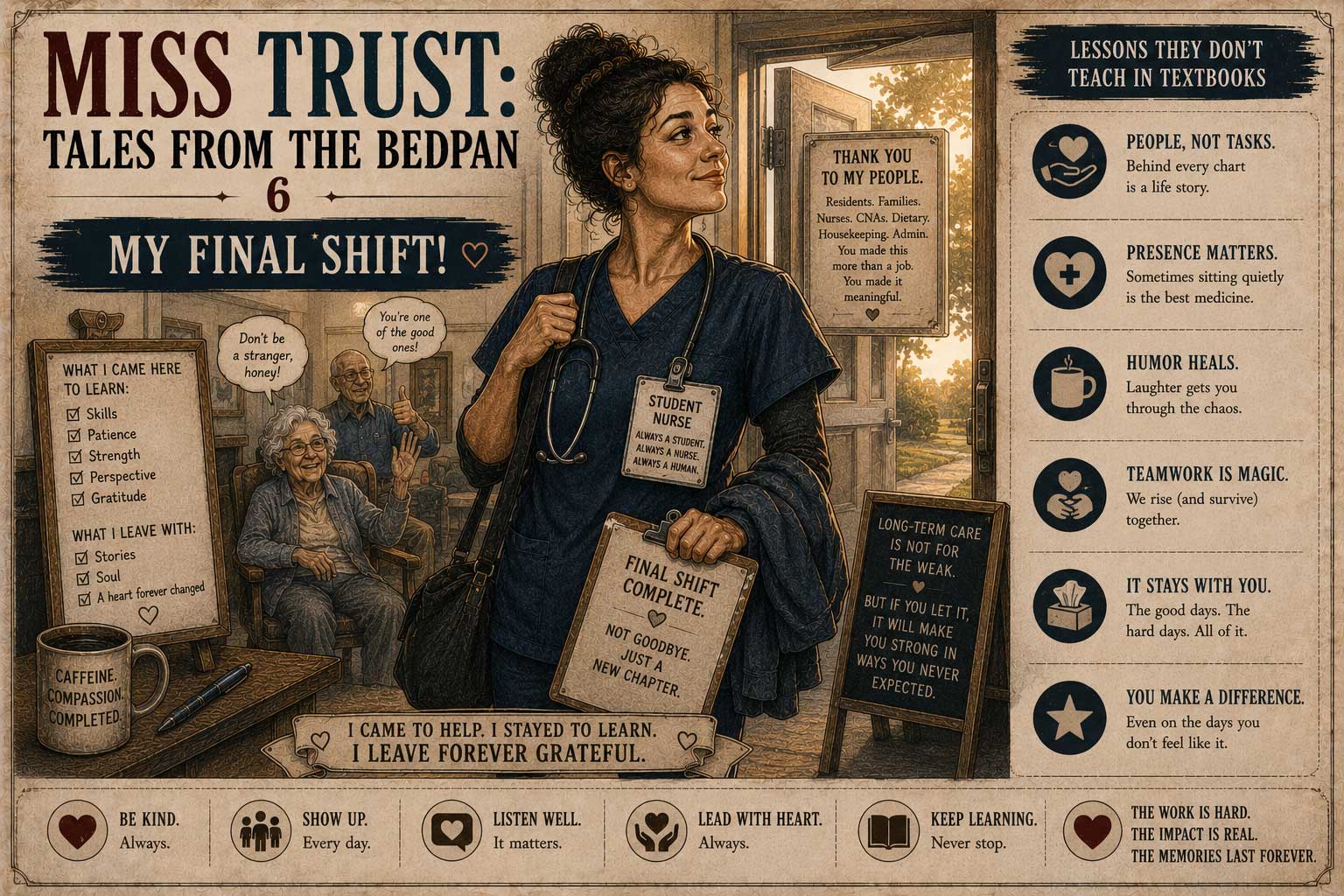
Shift #4: Part 1 – My Final Shift!
Today is my final shift at the Long Term Care (LTC) Centre, and my heart feels a mix of emotions. There’s a quiet excitement in stepping into this last chapter. Curiosity about what this final day will reveal, and anticipation, as I prepare for my next placement at the hospital.
However, as I reflect, I do have a bit of sadness. I’m leaving behind a place that has begun to re-define me, and started me on my ‘nursing journey’. Is it hard to imagine as a reader what I am feeling? The experiences I’ve had, the professional development I’ve achieved, and the meaningful connections I’ve formed here are profound to me. I think other nurses would know exactly what I mean. My perspectives have been altered, they have changed. Was this the point of starting us student nurses here in the LTC Centre? Probably? Maybe? It’s truly a bittersweet farewell.
My day started with the charge nurse doing her shift report for the PSWs, as usual. During the report, we were interrupted by an older gentleman who politely knocked on the door. He came in to inquire about his wife’s diet. His wife, who has dementia, had been gaining weight because she receives snacks whenever she asks, but apparently her husband explicitly asked the staff to stop giving her so many snacks. He expressed frustration, as his previous requests to monitor her food intake were overlooked. The charge curse responded attentively and documented his concerns to ensure they were followed. Additionally, all of the PSWs agreed to this request. This simple interaction was a reminder of the importance of clear communication, teamwork, and keeping the family in the loop, in complex cases, especially involving dementia.
After report, the next two hours were a blur, transferring residents out of bed, changing and cleaning, assisting with sudden and interrupting bathroom trips, and zipping around with the snack cart serving food. The fast pace, the adrenaline of moving quickly from one resident to the next, kept me going, ready, and alert. I was in my element! For some I think this might be too much, but for me, I loved it! The constant motion, the hands-on, ever-changing environment – it is exciting and I really feel accomplishment, which is my elixir to face new challenges and new days.
I worked alongside my preceptor and another PSW that I had not worked with during my placement. Something I instantly noticed about this PSW was their demeanour. Regardless of having the same responsibilities as my preceptor, and the other PSWs on the floor, she had a very stressful, and more task-focused disposition. I noticed this especially when she was interacting with the residents. She wasn’t unfriendly or anything like that, her approach was just so much more serious than what I had experienced so far. Comparably, my preceptor interacts with the residents in a very light and bubbly way. She often would add fun to the interactions and make jokes if she could. Since I had been shadowing her, I felt my personality started to mirror a similar approach – a good example of the importance of preceptors! After everything I saw and witnessed – being positive was really needed and I would say wanted by the residents. How an individual behaves and interacts really impacts the environment – and can rub off on everyone there.
At dinner time, we started gathering the residents and bringing them to the dining room. I went to the table I usually sit at to assist with the feeding where I found a new resident sitting there. I asked one of the PSWs if it was a mistake, and he explained to me that she now needed assistance with feeding – despite having been independent just a few weeks ago – and had therefore moved tables. I thought to myself, “Wow. I have only been here a short while, yet so much can change in that time”.
Watching this woman transition from being able to feed herself to needing full assistance was an eye-opening experience. She wasn’t even able to hold the cup by herself! Witnessing the progressive loss of ability was an insightful realization of how fragile all of us are or can be. My mind drifted to the possibility that this can happen to my family – to me. I was reminded of the critical impact that time and illness can have on these individuals’ independence and emphasized the significance of remaining patient and empathetic when providing care. I thought of my family. I thought of myself. What care will they have? What care will I have? I shouldn’t think about this, but how can anyone in healthcare, not wonder?
My last day was shaping up to be a ‘final hurrah,’ filled with unexpected twists and poignant moments—sort of like the one that had just unfolded before my eyes. It was as if the chaos of the moment demanded to be captured in verse:
Oh this shift, on my final day,
When twilight whispered soft dismay,
A chilling twist, a ghastly sight,
Did slice the fading, waning light.
Upon that hour, with quivering air,
A shadow moved, with deliberate care,
A resident, not always calm and meek,
Resumed a force no words could speak.
With savage grip, a fist did fly,
A blow, a scream, a strangled cry!
The PSWs stood firm, unmoved,
Their faces cold, their wills unproved.
In that bleak moment, heart did race,
A haunted chill disturbed my face.
What would I do? What course to take?
The fear within my chest did quake.
Yet, swift as nature’s relentless hand,
The staff, like guards, did take command,
And with grim calm, they did proceed,
To quell the storm and meet the need.
They removed the patient on that day,
And placed them safely from harm’s way,
Where perfumed flowers were in bloom
To still the rage, in the quiet room.
The chaos passed, the moment fled,
But in my soul, the echoes spread,
For in this place, where hearts are tried,
The struggle of life can never hide.
And just like that, the storm, the momentary chaos, among a regimented routine, had subsided. It was quiet again. The PSWs, with an almost practiced efficiency, responded to the resident’s aggression, de-escalating the situation before it could spiral out uncontrollably. I stood amazed – not just at their quick action but at their calm poise. For the unimpressed, it might have seemed like just another incident, but to me, it was an intense reminder of the spirit and silent strength that defines this work. There are no medals for this work.
There is a lot of physical work in an LTC. It’s not exactly hard, but it isn’t easy, nor is it straightforward. You can’t expect things to follow a set routine. You can plan your activities, but they seldom go according to schedule – at least, as a student, I couldn’t manage it. Not to discredit myself too much, I kind of anticipated this would happen. I wasn’t surprised by disruptions to any routine, but I didn’t expect the mental and emotional challenges that LTC work would bring. No textbook or lesson ever mentioned the mental and emotional stressors of the job.
One of the hardest things I had to accept while working at the LTC was that some residents truly had diminished cognition and were often unresponsive. I feel a lot of empathy for them. When helping put some residents to bed, I followed my preceptor to do “changes.” One of the residents had previously been upset and resistant to our efforts to clean them up. That incident made me more mindful of what it might feel like for the residents – a person, another human being – not just a task on a list of things to do. My preceptor explained that it is never easy, and if it ever becomes easy, that’s an alarm for you. Sometimes—emphasis on “sometimes”—you just have to do things, like the cliché, “Just do it,” even if the patient says no. She explained that it’s necessary to ensure residents are clean and comfortable; otherwise, they can develop sores or infections, which can lead to serious complications.
I won’t lie—this is an awful part of nursing. Cleaning patients can be a messy and unpleasant task. For some nurses, cleaning a patient isn’t a big deal. Some nurses’ hate dealing with blood, others dislike handling medications or IVs, and some find health assessments challenging. I haven’t been in nursing long enough to know for sure what I like or dislike, but cleaning residents is probably not in my top five things I like to do. And I’m sure, as a resident or patient, this is in their top five things they’d prefer not happen. For some this must be very demoralising, others might find it scary. Sometimes, if you can, acknowledging this mutual discomfort can lighten the stress of the task. Sometimes…you ‘Just Do it’!
I swallowed my pride. The resident couldn’t, and I can only imagine the thoughts that might have been racing through their mind. There must be fear – I know there is fear. How do you help them with that fear? My preceptor handled the task in what I would describe as a “zoned-out” state. She just focused on getting the work done. We worked quickly, even as the resident screamed, resisted, and pushed us away. Was it challenging? Yes, it was incredibly challenging.
How can I find a balance between respecting a patient’s independence and ensuring their well-being? How do I address their fear—their fear, and maybe even my own?